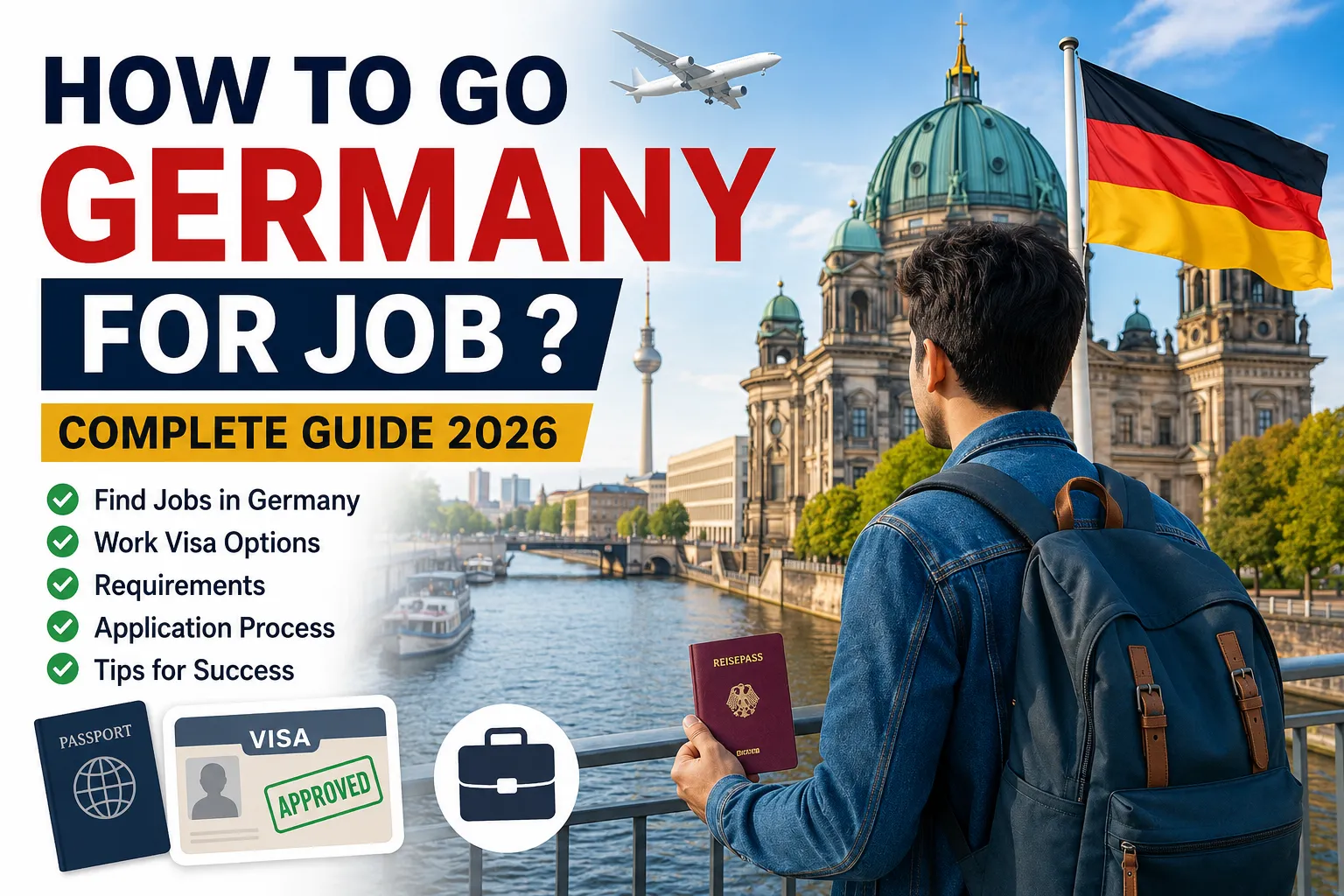
Germany is one of the most attractive destinations in Europe for skilled workers looking for better career opportunities, professional growth and a stable working environment. If you are living outside the European Union and want to go to Germany for a job, there are several legal routes available in 2026.
The most important thing to understand is that you generally cannot simply travel to Germany on a tourist visa and start working. Depending on your qualifications and situation, you may need a German work visa, EU Blue Card, Opportunity Card or another residence permit for employment.
This guide explains how to find a job in Germany, which qualifications you may need, how the visa process works, and how you can prepare your application.
How Can I Go to Germany for a Job?
For most people from countries outside the EU, the process looks like this:
Get qualified → Find a suitable job → Check qualification recognition → Apply for the appropriate visa → Travel to Germany → Start working
Germany’s Federal Employment Agency identifies qualified workers as an important group for the German labour market. Depending on your profession, you may need a university degree, vocational qualification or relevant professional experience.
You should therefore avoid paying agents who promise a “guaranteed Germany work visa” without first checking whether you qualify under German immigration rules.
Step 1: Check Whether You Are Eligible to Work in Germany
The first step is to determine whether your education, vocational training, skills and professional experience meet the requirements for employment in Germany.
Germany generally looks for qualified workers who can demonstrate one or more of the following:
- A university degree
- Recognized vocational training
- Relevant professional experience
- Professional qualifications required for a particular occupation
For some regulated professions, additional recognition or a professional licence is required.
Popular Fields for Foreign Workers
Opportunities can be found in different sectors, including:
- Information technology
- Engineering
- Healthcare and nursing
- Skilled trades
- Construction
- Manufacturing
- Logistics
- Hospitality
- Technical professions
- Research and science
The exact opportunities depend on your qualifications, experience, language skills and the current demand for your profession.
Step 2: Learn German
Learning German can significantly improve your chances of finding employment.
Although some international companies offer jobs where English is sufficient, many German employers expect applicants to have at least basic German skills. The Federal Employment Agency specifically recommends learning German because language skills improve employment prospects.
For many jobs, A2, B1 or B2 German can make a significant difference.
For regulated professions such as healthcare, the required language level may be specified as part of the recognition or professional licensing process.
Should You Learn German Before Going to Germany?
Yes, if possible.
You can start learning German while living in your home country. This can help you:
- Communicate with employers
- Understand job advertisements
- Prepare for interviews
- Deal with government offices
- Find accommodation
- Communicate at work
- Adapt to everyday life
Step 3: Get Your Qualification Recognized if Required
Qualification recognition is an important part of the process for many foreign workers.
Your foreign degree or vocational qualification may need to be recognized or assessed as comparable to a German qualification.
For regulated professions, recognition and/or a professional licence can be mandatory.
However, the rules are not identical for every profession and visa category. Therefore, check the recognition requirements for your specific occupation before applying.
Step 4: Find a Job in Germany
You can search for German jobs while you are still living in your home country.
This is often the safest approach because you can secure employment first and then apply for the appropriate visa.
Where Can You Find Jobs in Germany?
You can use reputable job platforms, company career pages and official government resources.
The Federal Employment Agency provides an official job search service, while the German government’s Make it in Germany portal provides job listings aimed at international applicants.
The Federal Employment Agency’s job database currently includes thousands of vacancies, including positions where English is mentioned in the job requirements.
When searching, use keywords related to your profession, such as:
- Software Developer Germany
- Nurse Germany
- Mechanical Engineer Germany
- Electrician Germany
- IT Specialist Germany
- Welder Germany
- Truck Driver Germany
- Healthcare Jobs Germany
- Construction Jobs Germany
Step 5: Prepare a German-Style CV
Your CV is one of the most important parts of your job application.
The Federal Employment Agency recommends a structured CV and says it should generally be no longer than two pages. It should include your employment history, education, relevant training, internships and language skills.
Your CV should normally include:
- Full name
- Contact information
- Professional experience
- Education
- Technical skills
- Language skills
- Certifications
- Relevant training
- Other job-related qualifications
Do not send exactly the same application to every employer. Tailor your CV and cover letter to the specific vacancy.
Step 6: Get a Job Offer
For several German employment visa routes, having a specific job offer from a German employer is an important requirement.
For example, the work visa for qualified professionals requires a specific job offer for qualified employment and a qualification recognized in Germany or comparable to a German academic qualification.
This means that simply having a degree does not automatically give you the right to work in Germany.
You must also satisfy the requirements of the relevant residence and visa category.
Step 7: Choose the Correct German Work Visa
There is no single “Germany work visa” that applies to everyone.
Your appropriate route depends on your qualifications, job offer, salary, profession and personal circumstances.
1. Work Visa for Qualified Professionals
This route can be suitable if you have a recognized qualification and a qualified job offer in Germany.
According to the official “Make it in Germany” information, the qualification must generally be recognized in Germany or comparable to a German academic qualification, and you need a specific job offer for qualified employment.
2. EU Blue Card
The EU Blue Card is another important route for highly qualified workers.
For 2026, the standard minimum gross annual salary for the EU Blue Card is €50,700. A lower threshold of €45,934.20 applies in certain shortage occupations and for certain young professionals, subject to the applicable conditions.
The job offer generally needs to be for at least six months and match the applicable qualification requirements.
3. Germany Opportunity Card
If you do not yet have a job offer, the Opportunity Card (Chancenkarte) may provide another route for eligible applicants.
The Opportunity Card allows eligible people from outside the EU/EFTA to come to Germany to look for employment.
There are different ways to qualify. For example, you may qualify as a recognized skilled worker, or you may qualify through the points system.
The Opportunity Card is initially issued for up to one year for job searching. During the job search period, holders can work part-time for up to 20 hours per week and may carry out job trials under the applicable rules.
Importantly, you do not necessarily need an Opportunity Card to search for a German job from your home country. You can also find an employer first and then apply for an appropriate employment visa.
Step 8: Apply for Your German Visa
Once you know which visa or residence route applies to you, you can begin the application process.
Germany has introduced a Consular Services Portal that allows applicants to submit online visa applications for employment and other purposes.
Depending on your situation, you may need documents such as:
- Valid passport
- Job offer or employment contract
- Educational certificates
- Qualification recognition documents, where required
- CV
- Proof of language skills, if applicable
- Health insurance information
- Proof of financial resources, where required
- Other documents requested by the relevant German mission
The exact document list depends on your visa category and personal circumstances.
Step 9: Attend the Required Visa Appointment
Even though parts of the process can be completed online, applicants may still need to complete identity verification, submit documents and provide biometric information according to the applicable procedure.
Always follow the instructions provided by the German mission or Consular Services Portal for your application.
Do not rely solely on information provided by an agent.
Step 10: Travel to Germany
Once your visa or residence authorization is approved, you can travel to Germany according to its conditions.
After arriving, you may need to complete local registration and residence formalities before or after starting employment, depending on your circumstances.
Your residence permit determines what work you are legally allowed to perform.
Can I Go to Germany Without a Job Offer?
In some circumstances, yes.
The Opportunity Card is specifically designed to allow eligible foreign nationals to enter Germany for job searching.
However, you still need to meet the relevant eligibility conditions.
If you already have a qualified job offer, applying for an employment-related visa may be more straightforward than entering Germany to search for work.
Can I Go to Germany on a Tourist Visa and Find a Job?
You should not plan to use a tourist or ordinary short-stay visa as a way to start working in Germany.
Germany’s visa information states that visa-exempt visitors generally cannot take up gainful employment during their short stay, and the appropriate visa or residence permission is required for employment.
If your purpose is employment, use the correct employment-related immigration route.
How Much Money Can You Earn in Germany?
Salary depends heavily on your profession, qualifications, experience, employer and location.
For comparison, Germany’s statutory minimum wage is €13.90 gross per hour from 1 January 2026. However, skilled professions can pay substantially more than the statutory minimum.
Examples of higher-paying sectors can include:
- IT
- Engineering
- Medicine
- Finance
- Specialized technical professions
- Management
- Research
Do not choose a profession solely based on salary. Consider qualification requirements, language requirements, living costs and the availability of jobs.
Is Germany Good for Pakistani Workers?
Germany can be an attractive destination for qualified Pakistani workers, particularly those with skills that are in demand.
Pakistani applicants should focus on:
- Getting a recognized qualification
- Improving German language skills
- Building relevant professional experience
- Creating a strong CV
- Applying directly to legitimate employers
- Understanding the correct visa route
- Avoiding fraudulent agents
The German government has specifically highlighted opportunities for skilled workers from non-EU countries, including people working in areas such as IT, care and skilled crafts.
Germany Jobs Without German Language – Is It Possible?
Yes, but opportunities are more limited.
Some international companies and jobs operate mainly in English. The official Federal Employment Agency job search also contains vacancies where English is relevant.
However, German language skills can greatly expand your options.
If you are serious about moving to Germany permanently, learning German should be part of your plan even if your first job does not require it.
How Much Does It Cost to Go to Germany for a Job?
There is no single fixed cost because expenses depend on your visa route and personal circumstances.
Potential expenses include:
- Language courses
- Language examination fees
- Qualification recognition
- Document translation
- Visa fees
- Travel expenses
- Air ticket
- Initial accommodation
- Health insurance
- Proof of financial resources, where applicable
- Residence-related costs
Be careful with agencies that demand very large payments for a “guaranteed Germany job.”
You can organize much of the process yourself using official German government resources. The Make it in Germany portal specifically notes that applicants can organize job searching, visa applications and entry themselves; using a service provider is not mandatory.
How to Avoid Germany Job Scams
Unfortunately, fake overseas job offers are common.
Be careful if someone promises:
- Guaranteed German work visa
- Guaranteed job without qualifications
- Guaranteed visa within a few days
- Job without an interview
- Very high salary for simple work
- Visa approval in exchange for a large upfront payment
Before paying anyone, verify the employer and vacancy.
Use official resources such as the German Federal Employment Agency and Make it in Germany.
Never submit your passport, money or sensitive documents to an unknown person without verifying who they are.
Germany Work Visa Process – Simple Checklist
Here is a simple checklist for applicants:
1. Check your profession
↓
2. Check your qualification
↓
3. Learn German
↓
4. Check recognition requirements
↓
5. Search for German jobs
↓
6. Prepare your CV and cover letter
↓
7. Apply to employers
↓
8. Receive a job offer
↓
9. Select the correct visa
↓
10. Submit your visa application
↓
11. Complete the required formalities
↓
12. Travel to Germany and start your career
Frequently Asked Questions
Can I go to Germany for a job from Pakistan?
Yes. Pakistani citizens can apply for the appropriate German employment visa if they meet the requirements of the relevant immigration route. Employment visa applications can be started through Germany’s Consular Services Portal.
Is a job offer required for a Germany work visa?
For several employment routes, yes. For example, the qualified-professional work visa requires a specific qualified job offer. However, the Opportunity Card provides an alternative route for eligible applicants who want to search for employment in Germany.
What is the Germany Opportunity Card?
It is a residence route for eligible people from outside the EU/EFTA who want to come to Germany to search for employment. It can initially be issued for up to one year.
Can I work part-time on the Opportunity Card?
Eligible Opportunity Card holders may work up to 20 hours per week while searching for suitable employment, subject to the applicable rules.
Do I need German language skills to work in Germany?
Not every job requires German, particularly some international or English-speaking positions. However, German language skills improve employment prospects and may be mandatory for certain professions.
Can I apply for Germany jobs from my home country?
Yes. You can search for jobs and apply to German employers while living abroad. If you receive a suitable offer, you can then apply for the relevant employment visa.
Can fresh graduates go to Germany for work?
Fresh graduates may qualify for certain routes depending on their degree, job offer, salary and other requirements. The EU Blue Card also has specific provisions for certain young professionals whose last degree was obtained less than three years ago.
Is Germany hiring foreign workers in 2026?
Germany continues to provide immigration routes for qualified workers from outside the EU, and official German sources highlight demand for skilled workers in areas including IT, care and skilled crafts.
Final Thoughts
Going to Germany for a job is possible, but it requires proper planning. The safest approach is to build the right qualifications, learn German, search for legitimate jobs, understand recognition requirements and apply for the correct visa.
If you already have a professional qualification and experience, start by searching for jobs from your home country. If you do not yet have a job offer, check whether you qualify for the Germany Opportunity Card.
Do not rely on social media agents or anyone promising a guaranteed visa. Use official German government resources to verify requirements before spending money or submitting important documents.
Useful Official Resources
Make it in Germany: Official information for international workers about jobs, visas, qualifications and living in Germany.
Federal Employment Agency: Official German employment service and job search platform.
German Consular Services Portal: Online visa application platform for eligible visa categories.
Always check the latest official requirements before applying because immigration rules, salary thresholds and procedures can change.